Goal
Understand matrices as transformations of space, not as tables of numbers. A matrix takes one vector and produces another, and the geometry of that map is the real object of interest.
Motivation
In machine learning, a model rarely works with raw vectors forever.
It turns one representation into another.
That may mean:
-
stretching some directions more than others;
-
rotating coordinates;
-
reflecting a space;
-
shearing it;
-
or combining several of those actions at once.
A matrix is the compact way to describe that behavior.
Prerequisites
-
Lesson 1: Vectors.
-
Comfort with coordinates and vector addition.
Notation / Symbol Table
| Symbol | Meaning |
|---|---|
A | A matrix or linear transformation. |
x | An input vector. |
W | A learned weight matrix in machine learning. |
b | A bias vector added after the matrix transform. |
I | The identity matrix, which leaves vectors unchanged. |
e_1, e_2 | Standard basis vectors. |
Core Ideas
A matrix is a function
The cleanest way to think about a matrix is as a map:
It takes a vector in one space and returns a vector in another.
That is why matrices feel so natural in programming: they are functions with a fixed structure.
The whole space moves together
When a matrix acts on the plane, it does not move each point independently.
It changes the coordinate grid itself.
That is why the same matrix can feel like a stretch, a rotation, a reflection, or a shear.
Columns tell you where the basis vectors go
The columns of a matrix are the images of the standard basis vectors.
If:
then:
That means a matrix is really a compact record of what it does to the basis.
Matrix-vector multiplication combines the columns
If:
then:
This is the column view of matrix multiplication, and it is often the most useful one for reasoning.
The identity matrix does nothing
The identity matrix satisfies:
It is the linear algebra version of multiplying by 1.
Why ML cares
Nearly every neural network layer uses a matrix multiply:
The matrix W reshapes the input, and the bias b shifts the result.
That is the basic pattern of many models.
Worked Example
Let:
Using row-by-row multiplication:
Using columns:
So:
Both views are the same idea. The column view is usually the one that makes the geometry click first.
Why This Shows Up In ML
Matrix layers are everywhere in machine learning because they are good at one thing:
taking a vector and changing its representation in a controlled way.
Examples include:
-
feature extraction;
-
hidden layers in neural networks;
-
learned embeddings;
-
coordinate changes;
-
and simple geometric transforms in vision models.
Exercises
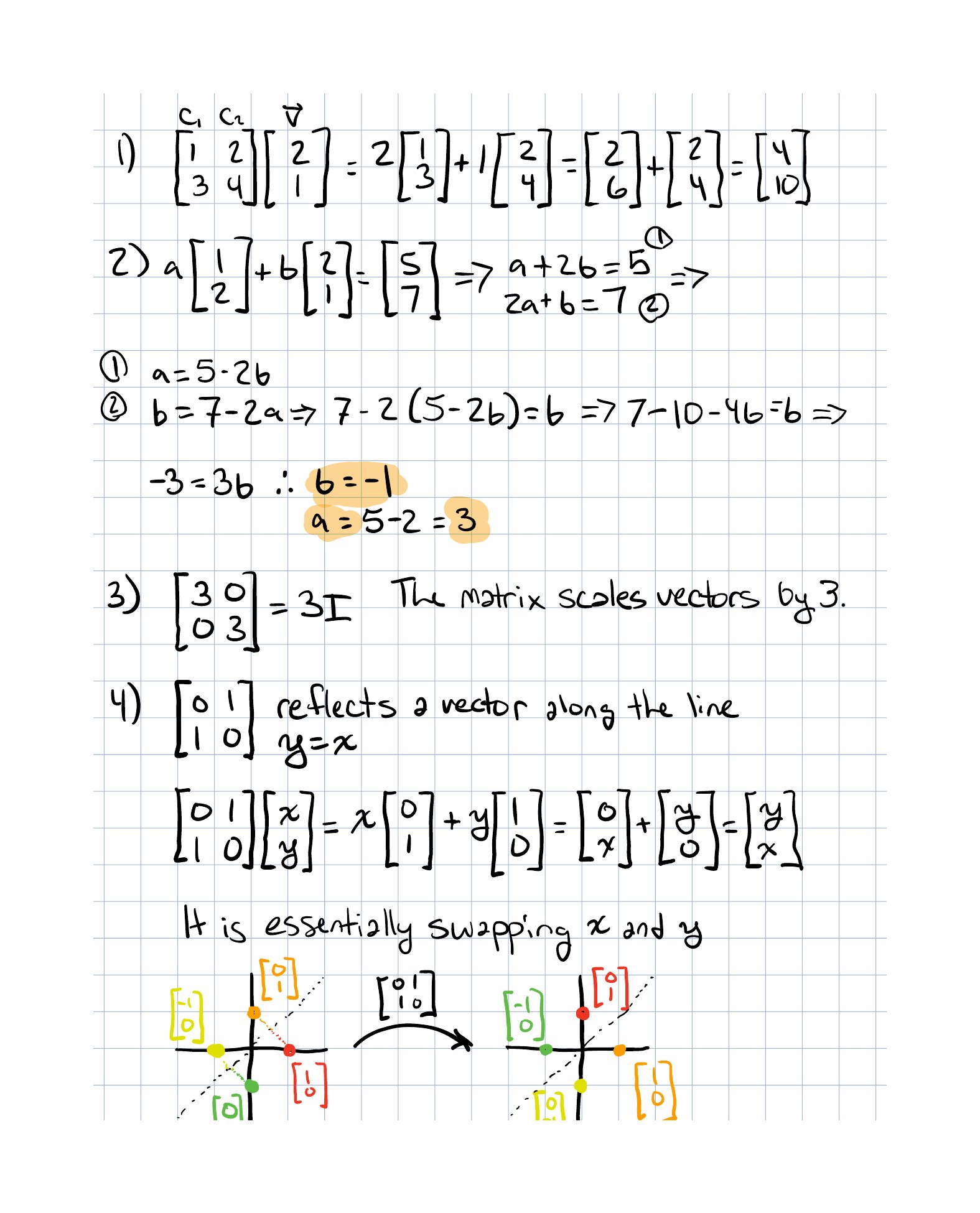
- Compute:
- Express
(5, 7)as a linear combination of the columns of
- Describe geometrically what
does to a vector.
- Describe geometrically what
does to a vector.
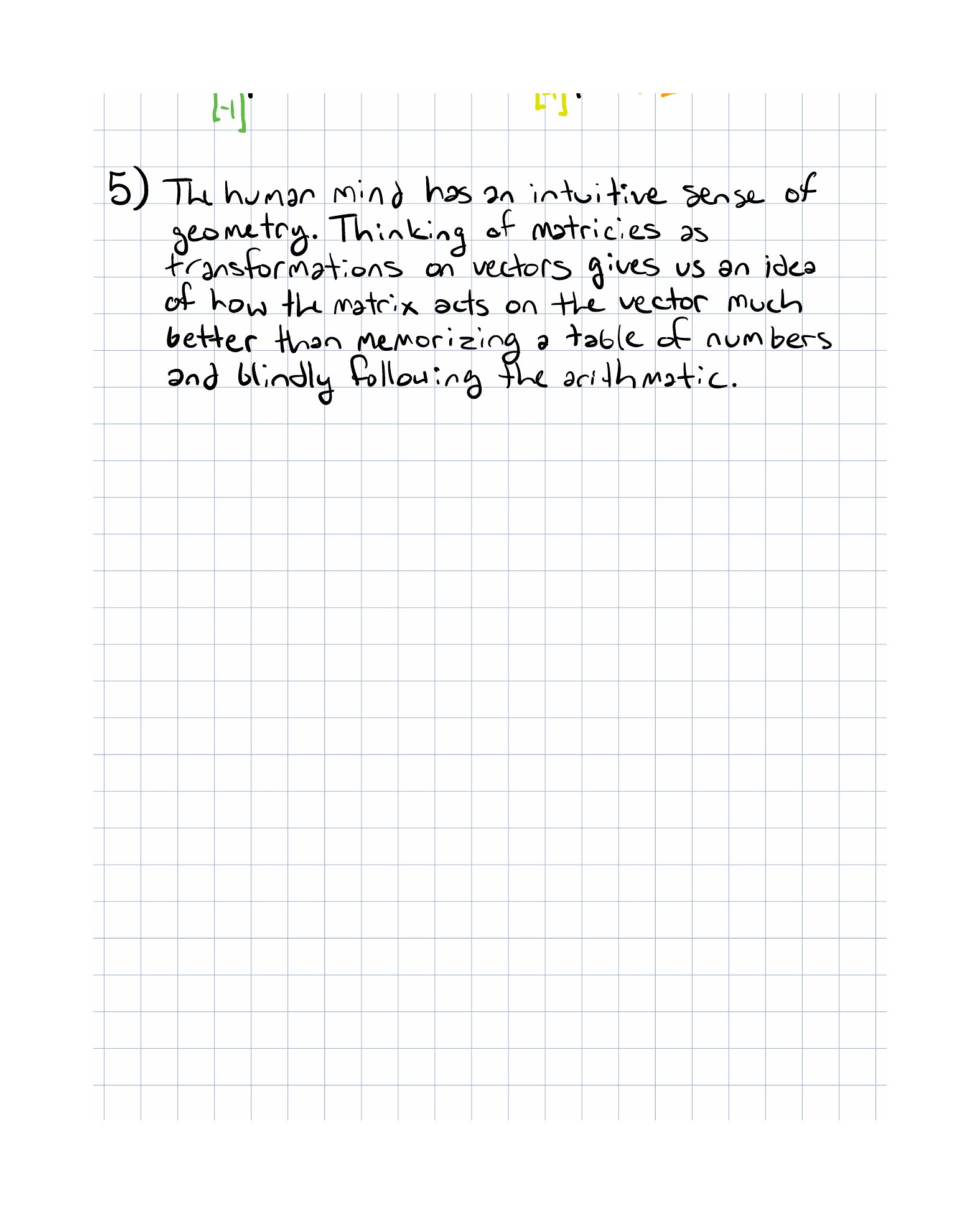
- Explain why it is enough to know what a linear transformation does to the basis vectors.
Implementation Exercise
Write a TypeScript helper that applies a 2 x 2 matrix to a 2-vector:
type Matrix2x2 = [[number, number], [number, number]];
type Vector2 = [number, number];

export function applyMatrix2x2(matrix: Matrix2x2, vector: Vector2): Vector2
Add a few small tests for scaling, reflection, and rotation.
Reflection Questions
-
Why is it useful to treat a matrix as a function?
-
What does each column of a matrix represent?
-
When does the row view help more than the column view?
-
Why is
Wx + bsuch a common pattern?
Completed Exercises
Handwritten work submitted after completing this lesson.