Goal
Understand the determinant as a geometric summary of a matrix. It measures how much a transformation scales area or volume, and it tells us when a transformation collapses information.
Motivation
Once you know that a matrix is a transformation, a natural next question appears:
How much does that transformation stretch or shrink space?
The determinant answers that question.
It also tells us something even more important:
Did the transformation destroy information?
Prerequisites
-
Lesson 3: Matrix Multiplication and Composition.
-
Comfort with 2D geometry and the idea of area.
Notation / Symbol Table
| Symbol | Meaning |
|---|---|
det(A) | The determinant of matrix A. |
A | A linear transformation whose area or volume scaling we are measuring. |
I | The identity matrix. |
orientation | The handedness of a transformation; whether it preserves or flips order. |
Core Ideas
The determinant measures scale
For a linear transformation in 2D, the determinant tells us how the area changes.
-
det(A) = 1means area is preserved. -
det(A) = 2means area doubles. -
det(A) = 0.5means area halves. -
det(A) = 0means the figure collapses into a lower-dimensional shape.
The same idea extends to volume in 3D and to higher-dimensional spaces.
A diagonal matrix makes the scaling obvious
If:
then the unit square becomes a rectangle with area 2 \cdot 3 = 6.
So:
A shear can preserve area
If:
the square becomes a parallelogram, but its area stays the same.
So:
Zero determinant means collapse
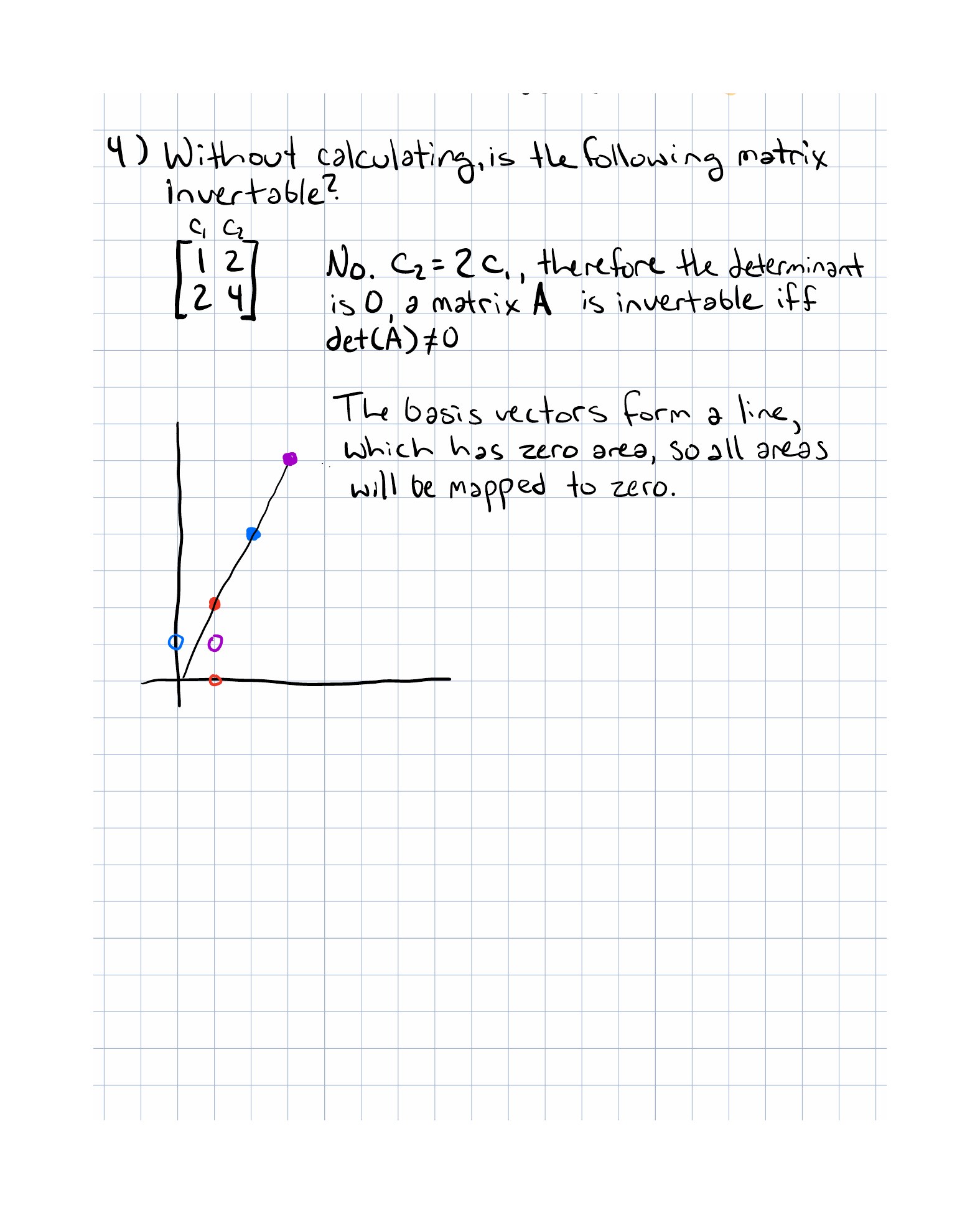
If the columns of a matrix are dependent, the transformation flattens the plane into a line or a point.
Once that happens, the lost dimension cannot be recovered.
That is why det(A) = 0 is the warning sign for non-invertibility.
The sign tells you about orientation
Positive determinant:
- preserves orientation.
Negative determinant:
- flips orientation.
A reflection has negative determinant because it reverses handedness.
The 2x2 formula is the algebraic summary
For:
the determinant is:
The formula is useful, but the geometric meaning comes first.
Worked Example
Consider:
Using the 2x2 formula:
Geometrically, the second column is twice the first column, so the transformation sends the plane onto a line.
That means:
-
area becomes zero;
-
information is lost;
-
the matrix cannot be inverted.
Now compare with:
This is a shear. It changes shape, but not area, so det(B) = 1.
That contrast is the main lesson: determinant is a geometric summary, not just a formula.
Why This Shows Up In ML
Determinants appear in a lot of places where geometry and probability overlap:
-
determining whether a matrix is invertible;
-
change of variables in calculus;
-
Jacobians in probabilistic modeling;
-
covariance geometry;
-
and the structure of transformations used in optimization and density estimation.
If a model maps many points to the same output, the determinant story helps explain why that matters.
Exercises
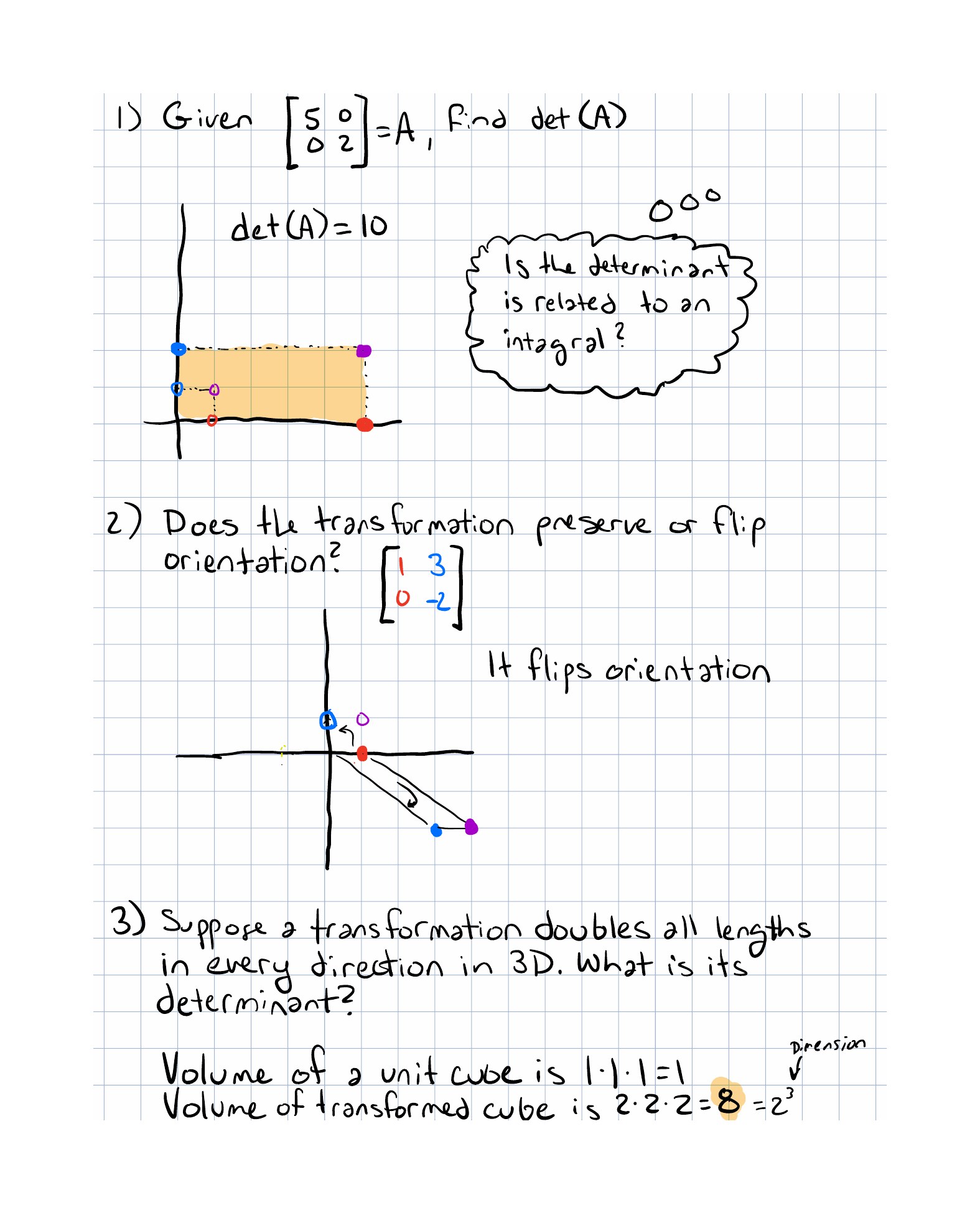
- Find the determinant of
- Decide whether
preserves or flips orientation.
-
If a transformation doubles every length in every direction in 3D, what is its determinant?
-
Explain why
cannot be invertible.
- Explain the determinant as a local area or volume scaling factor in your own words.
Implementation Exercise
Write a small TypeScript helper that computes the determinant of a 2 x 2 matrix and uses it to test invertibility:
type Matrix2x2 = [[number, number], [number, number]];

export function determinant2x2(matrix: Matrix2x2): number

export function isInvertible2x2(matrix: Matrix2x2): boolean
Add tests for a diagonal matrix, a shear, and a collapsed matrix.
Reflection Questions
-
Why is zero determinant such a strong warning sign?
-
What does a negative determinant tell you that a positive one does not?
-
Why is the geometric meaning more memorable than the formula alone?
-
Where in machine learning does “how much does this transformation scale space?” show up again?
Completed Exercises
Handwritten work submitted after completing this lesson.