Goal
Understand inverse matrices as undoing maps. If a matrix sends a vector somewhere, the inverse sends it back.
Motivation
The idea of “undo” appears everywhere in math and programming.
-
Undo a rotation by rotating back.
-
Undo a scale by dividing by the scale factor.
-
Undo a transformation by applying its inverse.
Inverse matrices are the linear algebra version of that idea.
Prerequisites
-
Lesson 4: Determinants.
-
Comfort with matrix-vector multiplication.
Notation / Symbol Table
| Symbol | Meaning |
|---|---|
A^{-1} | The inverse of matrix A, if it exists. |
I | The identity matrix. |
A x = b | A linear system that may be solved using an inverse when one exists. |
x | An unknown vector to solve for. |
b | A known output vector. |
Core Ideas
The inverse undoes the transformation
The inverse matrix A^{-1} is defined by:
Equivalently:
That is the entire definition in one line.
The identity matrix does nothing
The identity matrix is the linear algebra version of 1.
It leaves every vector unchanged:
So if a matrix and its inverse are multiplied together, the result must be the identity.
Not every matrix has an inverse
If a transformation collapses space, information is lost.
Once two different inputs end up at the same output, no inverse can separate them again.
That is why singular matrices, the ones with det(A) = 0, do not have inverses.
Solving a system is really an undoing problem
If:
and A^{-1} exists, then:
This is one reason inverse matrices matter so much.
In practice, numerical software often solves the system without explicitly forming the inverse, because that is usually faster and more stable.
Worked Example
Let:
This matrix doubles every vector.
To undo that, the inverse must halve every vector:
Check the result:
Now consider:
This matrix collapses the plane onto a line, so det(B) = 0.
That means there is no inverse.
The geometric reason is simple:
once the transformation has destroyed a dimension, there is no unique way to recover it.
Why This Shows Up In ML
Inverse matrices appear in many places around machine learning and numerical computing:
-
solving linear systems;
-
least-squares methods;
-
covariance calculations;
-
whitening;
-
Gaussian models;
-
and Kalman-style estimation problems.
The important practical lesson is that “having an inverse” is not the same as “always computing it directly.”
Exercises
-
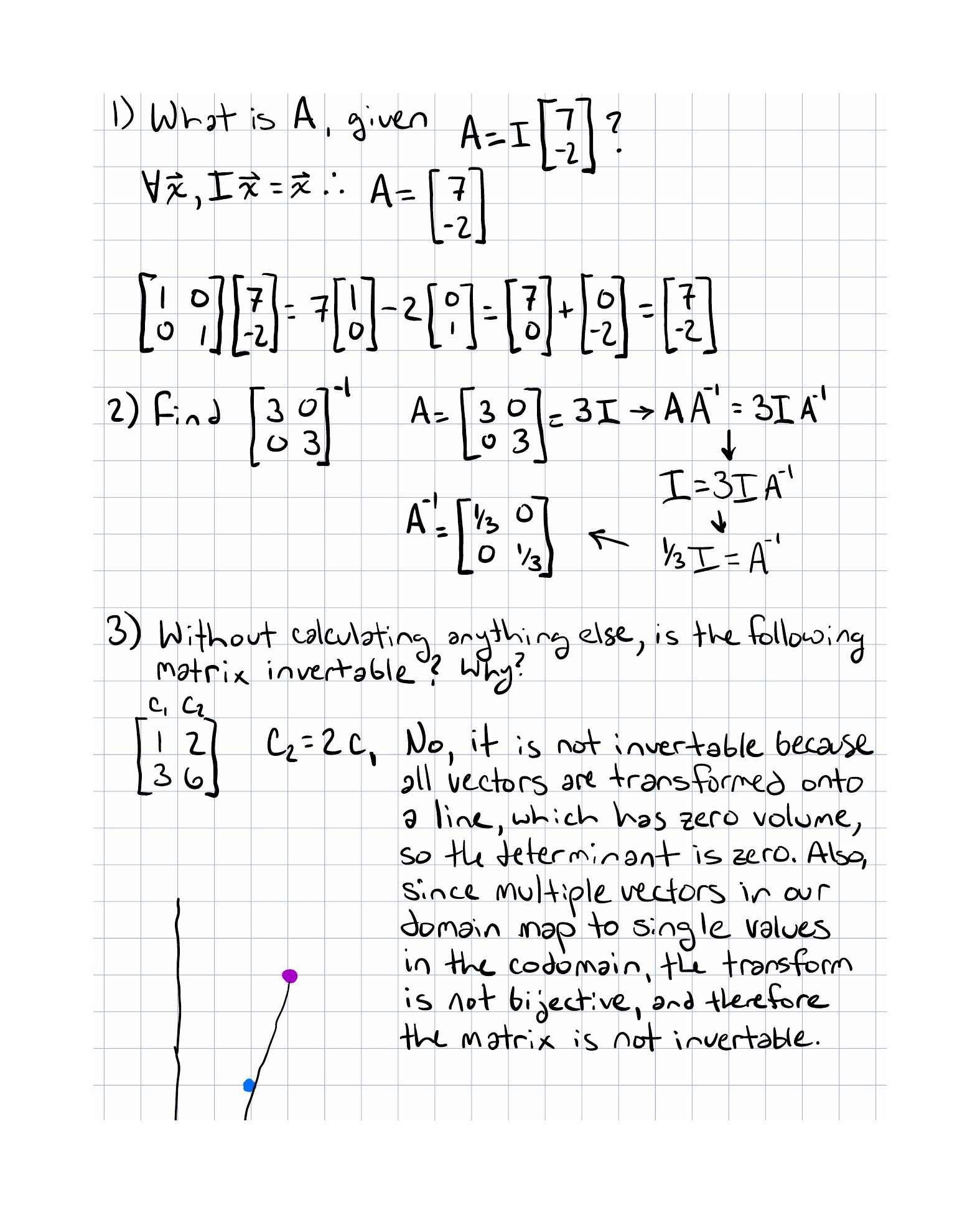
What is
Iapplied to the vector(7, -2)? -
Find the inverse of
- Decide whether
has an inverse, and explain why.
-
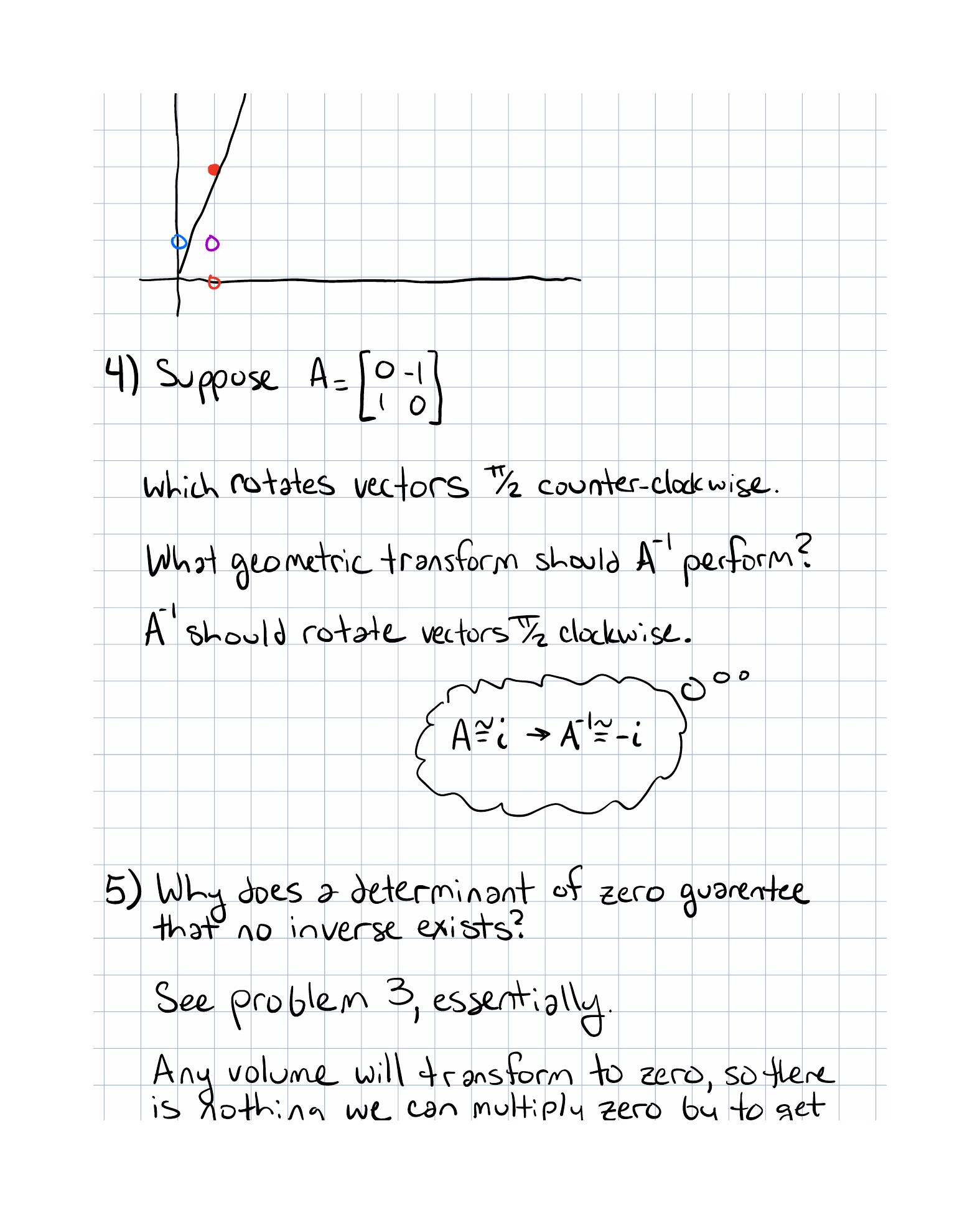
If
Arotates vectors by90^\circcounterclockwise, what shouldA^{-1}do? -
Explain why determinant zero guarantees that no inverse exists.
Implementation Exercise
Write a TypeScript helper that computes the inverse of a 2 x 2 matrix when it exists:
type Matrix2x2 = [[number, number], [number, number]];
type Vector2 = [number, number];

export function inverse2x2(matrix: Matrix2x2): Matrix2x2 | null
Then verify that multiply2x2(matrix, inverse) gives the identity matrix for a few invertible examples, and returns null for a collapsed matrix.
Reflection Questions
-
What geometric event makes a matrix non-invertible?
-
Why is the determinant the first quick test for invertibility?
-
How is solving
A x = brelated to undoing a transformation? -
Why do numerical libraries often avoid forming the inverse explicitly?
Completed Exercises
Handwritten work submitted after completing this lesson.