Goal
Understand early stopping as a practical rule for keeping the checkpoint that generalizes best, rather than assuming the model from the last training epoch is automatically the best model.
Motivation
Regularization changes the objective. Early stopping changes the training procedure.
The question here is:
If training keeps reducing the training loss, why would we ever stop before the end?
The answer is that the model can keep getting better at memorizing the training set while getting worse on unseen data. Validation metrics help us see that moment.
Prerequisites
- Lesson 22: Model Complexity.
- Lesson 23: Regularization.
- Basic familiarity with training loops and the idea of repeated epochs over a dataset.
Notation / Symbol Table
| Symbol | Plain-English name | Meaning |
|---|---|---|
e | epoch | One pass through the training data. |
L_train(e) | training loss | Loss measured on the training set after epoch e. |
L_val(e) | validation loss | Loss measured on a held-out validation set after epoch e. |
e_best | best epoch | The epoch whose validation performance is best so far. |
p | patience | The number of non-improving epochs we allow before stopping. |
Core Ideas
We Usually Need Three Data Splits
The standard separation is:
- training set: used to learn parameters
- validation set: used to make design decisions
- test set: used once for the final unbiased report
That distinction matters because evaluation can leak into training. If you keep peeking at the test set and adjusting decisions, it stops being a real test set.
Training Curves And Validation Curves Behave Differently
Training loss often keeps decreasing for a long time. Validation loss behaves differently.
At first:
- training loss goes down
- validation loss also goes down
Later, once the model starts memorizing:
- training loss still goes down
- validation loss flattens or rises
That rise is one of the clearest signs of overfitting during optimization.
Early Stopping Chooses The Best Validation Checkpoint
The rule is simple:
Keep track of the checkpoint with the best validation score, and stop training once improvement has meaningfully stopped.
The deployed model is not necessarily the final one. It is the one stored at e_best.
This is a deep habit shift for beginners. “Trained longer” is not automatically “better.”
Why Early Stopping Regularizes
Large models often learn broad patterns first and noisy idiosyncrasies later.
Early stopping works because it interrupts the training process before memorization becomes dominant.
So even though the architecture does not change, the effective learned function stays simpler than the function you might get after excessive training.
That is why early stopping is legitimately a regularizer.
Patience Prevents Overreacting To Noise
Validation metrics are noisy. A single bad epoch does not necessarily mean generalization has started collapsing.
That is why many training loops use patience:
Stop only after the validation metric has failed to improve for several consecutive epochs.
Patience smooths out random bumps and makes the stopping rule less jumpy.
Parameters Versus Hyperparameters
Early stopping also clarifies an important distinction.
Weights are learned automatically from the training data. The stopping rule is chosen by the practitioner.
That makes the stopping policy a hyperparameter choice, not an ordinary parameter value.
The same is true for:
- learning rate
- regularization strength
- dropout rate
- model architecture
Worked Example
Example 1: Picking The Best Epoch
Suppose the losses evolve like this:
| Epoch | Train loss | Validation loss |
|---|---|---|
| 1 | 0.92 | 0.95 |
| 2 | 0.71 | 0.74 |
| 3 | 0.55 | 0.58 |
| 4 | 0.43 | 0.47 |
| 5 | 0.34 | 0.45 |
| 6 | 0.26 | 0.46 |
| 7 | 0.19 | 0.50 |
The lowest validation loss occurs at epoch 5, so epoch 5 is the checkpoint to keep.
Epoch 7 fits the training set better, but it generalizes worse.
Example 2: Why Patience Helps
Suppose validation losses look like:
0.42
0.41
0.40
0.401
0.399
0.402
If you stop immediately after 0.401, you stop too soon. The next epoch actually improves to 0.399.
That is exactly what patience protects against.
Why This Shows Up In ML
Early stopping matters because training is expensive and generalization is the goal.
In practical ML systems, it helps you:
- avoid wasting compute once validation performance has peaked
- keep the best checkpoint instead of the last checkpoint
- treat validation metrics as part of model selection
- separate parameter learning from outer-loop training decisions
It is also one of the most accessible regularizers because it does not require changing the loss function at all.
Exercises
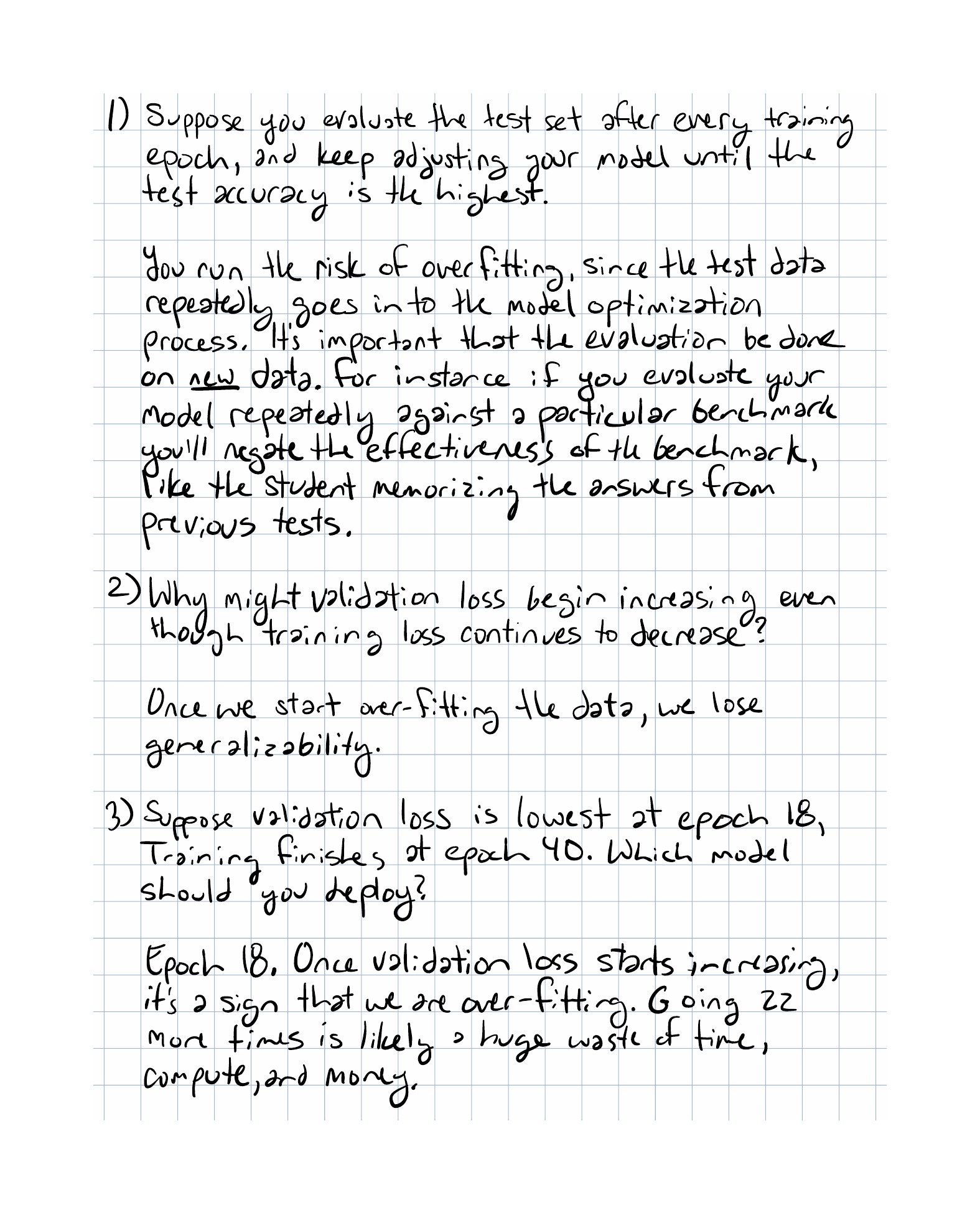
- Why is it a mistake to evaluate the test set after every epoch and use that to choose when to stop?
- If training loss keeps decreasing but validation loss starts increasing, what is the model probably learning?
- Suppose validation loss is lowest at epoch 18 but training ends at epoch 40. Which checkpoint should you deploy, and why?
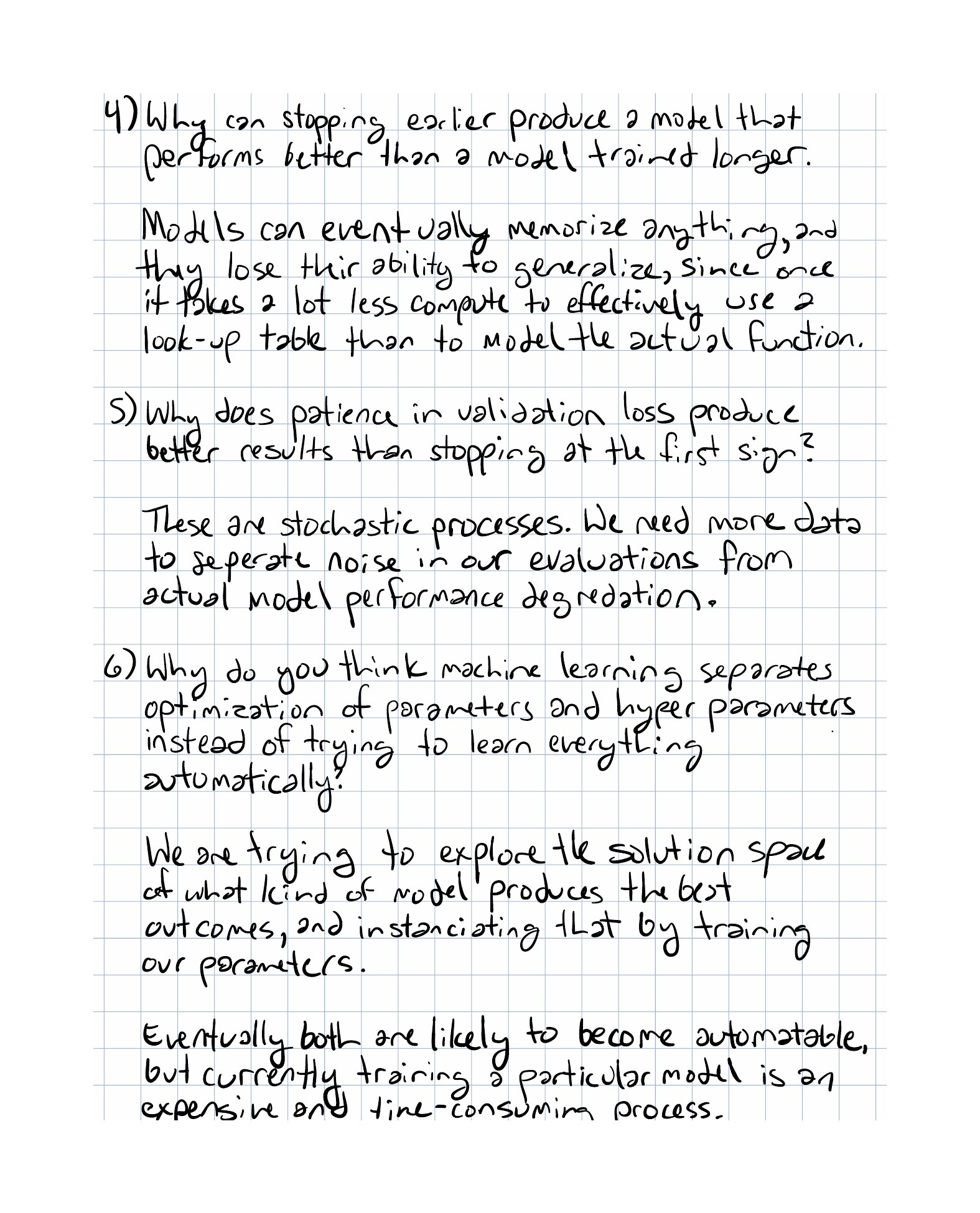
- Why can a model trained for less time outperform the same architecture trained for longer?
- Why is patience usually better than stopping after the first validation setback?
Implementation Exercise
Write a TypeScript helper that scans a sequence of validation losses and returns:
- the best epoch index
- the best validation score
- the epoch where patience would trigger stopping
Use a shape like:
type EarlyStoppingResult = {
  bestEpoch: number;
  bestValue: number;
  stopEpoch: number;
};
Then feed it a few synthetic validation curves and check that it chooses the checkpoint you would choose by inspection.
Reflection Questions
- Why does the validation set behave more like a trusted editor than a final public review?
- Which feels more intuitive to you: early stopping as a compute-saving trick or as a regularizer?
- What is the difference between a weight learned by gradient updates and a stopping rule chosen from validation behavior?
- How would you explain to someone why “more training” is not always “more learning”?
Completed Exercises
Handwritten work submitted after completing this lesson.